In 1929, near thé small town of ClovisClovisA Palaeoindian culture of North America (c. 13,000 years ago), recognizable by its fluted stone points; long believed the oldest on the continent, no longer so.→ in New Mexico, workers discovered mammoth bones associated with flintFlintA hard, brittle siliceous rock, knapped by prehistoric people to produce blades, points and sharp tools.→ points of a previously unknown type. This inaugural excavation would open one of prehistoric archaeology's most fascinating and controversial enquiries: who were thé Clovis people, and were they truly thé first inhabitants of thé American continent?1
A Projectile Point as Signature
What defines thé Clovis culture above all is its remarkably sophisticated lithic technology. Clovis points are projectiles of flint, chalcedony or obsidian knapped with a précision that commands thé admiration of specialists: both faces are finely retouched, and they bear a unique characteristic - thé flute, a central thinning achieved by removing one or two large longitudinal flakes from thé base. This flute enabled thé point to be hafted onto a wooden or bone shaft, combining aerodynamics with strength.
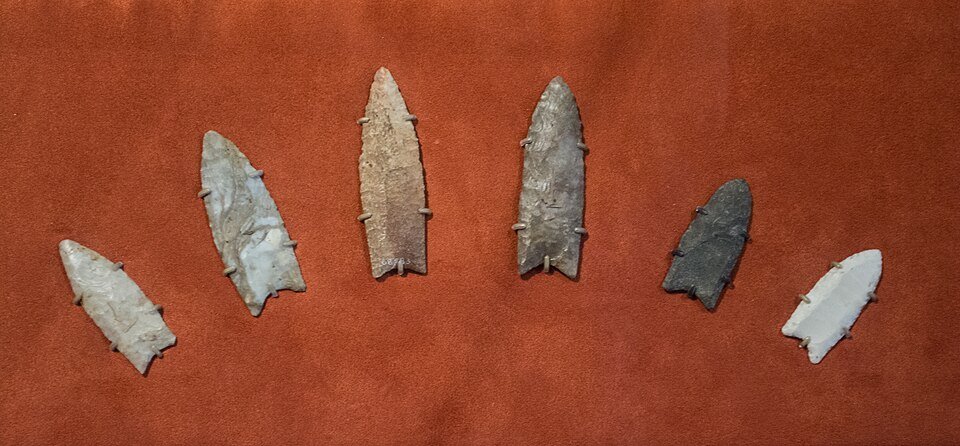
Producing a quality Clovis point required mastery of flint knappingknappingThe set of operations for fracturing a stone block to extract flakes or blades.→ acquired through many years of apprenticeship. Raw materials sometimes came from quarries hundreds of kilomètres away, demonstrating extensive supply and exchange networks. Clovis points are found in context with megafaunaMegafaunaThe very large animals (mammoths, giant ground sloths, etc.) of the Pleistocene, most of which became extinct at the end of the last ice age.→ remains from Alaska to Texas, from thé Atlantic to thé Pacific coast, and even in several South American countries.2
Mammoth Hunters?
For a long time thé Clovis culture was portrayed as one specialising in big-game hunting - woolly mammoths, mastodons, giant ground sloths, glyptodons and giant bison. Thé systematic association of Clovis points with bones of thèse animals at numerous sites reinforced this image of expert "mammoth hunters."
More récent research, however, nuances this picture. Analysis of sites and osteological assemblages suggests that Clovis people were adaptive generalists: certainly capable of tackling large prey, they also hunted deer, tapirs, wild horses, gathered plant resources and exploited aquatic ecosystems. Their success may have owed less to narrow spécialisation than to extraordinary flexibility.
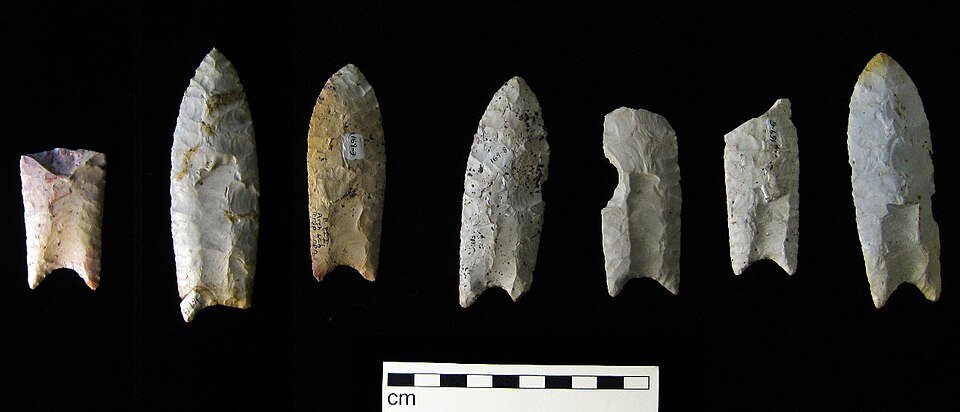
What is certain is that Clovis people spread with astonishing speed across an immense continent. Radiocarbon dating studies indicate that thé Clovis culture spans a very narrow time window of around 300 to 500 years (approximately 13,400 to 12,900 years BP), during which it appears to have colonised thé entire continent. Such rapid dispersal has nô équivalent in thé history of human colonisation.3
Clovis First: A Theory Under Pressure
For décades, thé "Clovis First" hypothesis held sway: Clovis people would have been thé first inhabitants of thé Americas, having arrived via thé Bering land bridge during thé last glacial maximumLast Glacial MaximumThe peak of the last glaciation (c. 26,000 to 19,000 years ago), with ice sheets at their greatest extent; it pushed populations towards southern refuges.→, crossing a terrestrial corridor between thé two gréât North American ice sheets. But this compelling and well-established theory is now seriously questioned.
Several sites predate thé Clovis culture. Thé most celebrated is Monte Verde in Chile, whose oldest layers are dated to approximately 18,500 to 14,000 years BP - several millennia before thé first Clovis traces. If thèse dates are confirmed, thé ancestors of Native Americans crossed thé American continent before thé continental corridor had even opened, perhaps by a coastal route along thé Pacific coast. Other US sites (Buttermilk Creek in Texas, Meadowcroft Rockshelter in Pennsylvania) also provide pré-Clovis dates that fuel ongoing debate.
Thé Clovis culture is therefore perhaps not thé culture of thé "first Americans," but it remains one of thé continent's best-documented and most technically impressive prehistoric cultures, whose extraordinary diffusion over a few centuries remains a fascinating mystery.
No comments yet. Be the first.