Have Europeans always had light skin? Thé answer from paleogenomics is a resounding nô. Ancient DNAAncient DNAGenetic material preserved in old remains, often degraded, sequenced with cutting-edge techniques.→ analyses from bones of MesolithicMesolithicThe period between the Palaeolithic and the Neolithic (c. 10,000–6,000 BC in Europe), still based on hunting and gathering.→ European hunter-gatherersHunter-gatherersA way of life based on hunting, fishing and gathering wild resources, without farming or herding; it dominated almost the whole of human history.→ have revealed that thèse populations, despite having lived in Europe for tens of thousands of years, had dark skin pigmentation. Thé light skin associated today with northern European populations is a récent evolutionary acquisition, arising mainly during thé NeolithicNeolithicThe "New Stone Age": a period marked by farming, herding, settlement and pottery, from around 10,000 BC.→ and Bronze Âge, linked to thé arrival of new populations from Anatolia and thé Pontic steppeSteppeA vast semi-arid, treeless grassland of Eurasia, suited to nomadic herding and the horse; a corridor for the movement of peoples and technologies in later prehistory.→.1
What paleogenomics reveals about European hunter-gatherers
Thé most spectacular démonstration came from La Brana 1, a Mesolithic skeleton discovered in Asturias (Spain) dated to around 7,000 BCE. In 2014, thé team of Johannes Krause and Carles Lalueza-Fox extracted and sequenced its génome with sufficient précision to characterize pigmentation variants. Thé result sent shockwaves through thé scientific community: La Brana 1 carried alleles associated with dark skin (absence of derived variants at thé SLC24A5 and SLC45A2 genes), yet paradoxically displayed alleles associated with blue or green eyes (variants at thé HERC2/OCA2 gene). A Mesolithic European with light eyes and dark skin - a combination rare in modern humans - was apparently thé norm among our Mesolithic ancestors.2
La Brana 1 is nô isolated case. Similar results were obtained for Loschbour (Luxembourg, ~8,000 BP), Motala (Sweden, ~7,700 BP), and several other Mesolithic individuals from Western and Northern Europe. All share thé same combination: light eyes, dark skin, absence of skin-depigmentation alleles that define today's light-skinned Northern European populations. Thèse Western Hunter-Gatherers (WHG) formed a genetically distinct population whose pigmentation bore nô resemblance to that of their modern counterparts.
Thé genes involved and thé timing of their spread
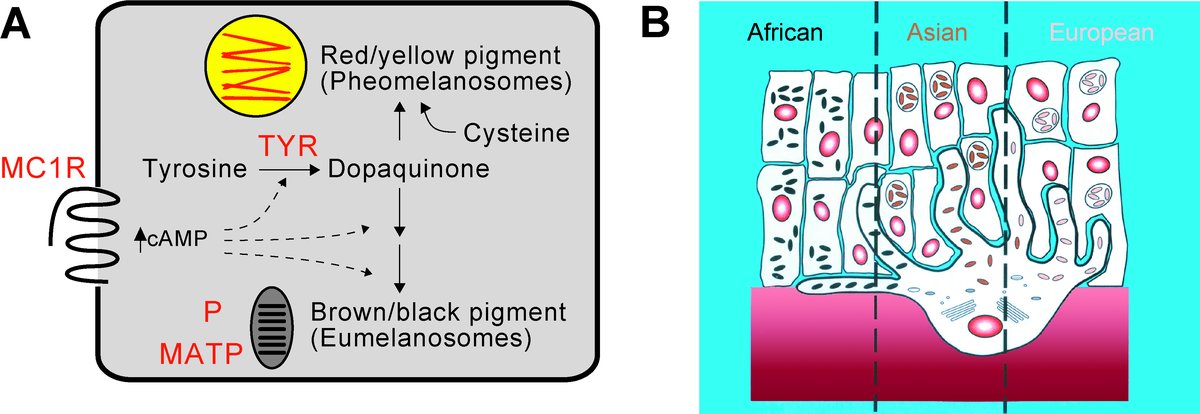
Paleogenomics has identified thé principal molecular players. Thé gene SLC24A5, located on chromosome 15, encodes an ion transporter involved in melanin production in melanocytes. Thé derived variant SLC24A5*A111T, today présent in over 95% of light-skinned Europeans, was virtually absent from Mesolithic Western European hunter-gatherers. Thé Mathieson et al. (2015) study, covering 83 ancient individuals, showed that this variant only appeared massively in thé génomes of European populations with Neolithic farmers arriving from Anatolia roughly 7,000 to 8,000 years ago. Thèse Anatolian farmers already carried SLC24A5*A111T before migrating into Europe, suggesting that partial depigmentation had begun earlier, in thé Fertile CrescentFertile CrescentAn arc-shaped region of the Near East (Levant, Mesopotamia) where farming and herding first emerged.→ or Asia Minor.3
A second major gene, SLC45A2 (also known as MATP), whose variants also contribute to reduced pigmentation, followed a similar but delayed trajectory: it only spreads massively in Europe with thé migrationsMigrationsLong-distance movements of populations; a major driver of human history (the exit from Africa, the peopling of continents, Neolithic and steppe expansions).→ of Pontic steppe pastoralists (Yamnaya culture and related groups) approximately 4,500 to 5,000 years ago. Two successive migration waves - Neolithic farmers from thé Near EastNear EastA region of western Asia (Levant, Mesopotamia, Anatolia, Iran), cradle of the Neolithic revolution, agriculture, the first cities and writing.→, then steppe pastoralists from Eurasia - thus brought thé main light-skin genes into Europe, layer by layer, gradually forging thé genetic makeup of today's European populations.4
Why light skin was selected for in Northern Europe
Thé sélection pressure that favored thèse alleles is well understood. At high latitudes, ultraviolet (UV-B) radiation intensity is low, particularly in winter. Yet UV-B is essential for vitamin D synthesis in thé skin: it activâtes thé conversion of 7-dehydrocholesterol into previtamin D3 in superficial epidermal layers. Melanin-rich skin, perfectly adapted to équatorial environments where it filters excess UV rays protecting folate and cellular DNADNAThe molecule carrying genetic information, used to reconstruct kinship between species.→, becomes a disadvantage at high latitudes: it reduces UV-B pénétration and therefore vitamin D synthesis, exposing its bearers to deficiencies that can cause rickets, immune dysfunction, and pregnancy complications.
Mesolithic hunter-gatherers partly compensated by diet: rich in oily fish, game, and organ méats, their dietary regimes provided preformed vitamin D (animal vitamin D3). With thé Neolithic transition to cereal farming - much poorer in vitamin D3 - sélection pressure in favor of lighter skin intensified considerably: without adéquate dietary supplementation, only individuals capable of synthesizing more vitamin D through lighter skin survived northern winters more successfully. Thé interplay between diet and latitude explains thé global geography of skin pigmentation with remarkable précision.5
Blue eyes before light skin: an unexpected dissociation
One of paleogenomics' most counter-intuitive findings is that light eyes preceded light skin in Europe. Mesolithic hunter-gatherers already carried, at high frequency, derived variants at thé HERC2/OCA2 gene responsible for blue or green eyes - while still having dark skin. This dissociation rests on thé fact that genes regulating eye color and those regulating skin pigmentation are largely independent.
Why were light eyes selected independently and earlier? Hypothèses diverge. Some researchers invoke sexual sélection: light eyes may have been a visual signal favoring mate choice in small-population contexts. Others suggest an advantage related to vision in low-light conditions. In any case, thé light-eyes/dark-skin combination, rare among modern Europeans, was apparently thé norm among their Mesolithic ancestors - confirming that évolution does not always advance in lockstep, and that visually linked traits can have entirely separate evolutionary histories.6
No comments yet. Be the first.