In thé middle of thé Egyptian désert, about 100 kilometers south of Cairo, stands a strange silhouette: a masonry tower rising from rubble as if violently stripped of its sides. This is thé pyramid of Meidum, one of ancient Egypt's most enigmatic monuments, whose construction secrets continue to fascinate archaeologists.1
Thé Meidum pyramid was probably begun by PharaohPharaohThe title of the ruler of ancient Egypt, regarded as a living god guaranteeing cosmic order (Maat), supreme head of state, army and worship.→ Huni, last king of thé Third Dynasty, and completed by his successor Sneferu. It was first built as a seven-stepped pyramid, then enlarged to eight steps, before Sneferu filled in thé steps to create a smooth-sided pyramid. This progressive transformation is visible today in thé monument's cross-section, a true architectural stratigraphyStratigraphyThe study of the superimposed layers (strata) of an archaeological site; each layer corresponds to a phase of occupation and yields a relative chronology.→.2
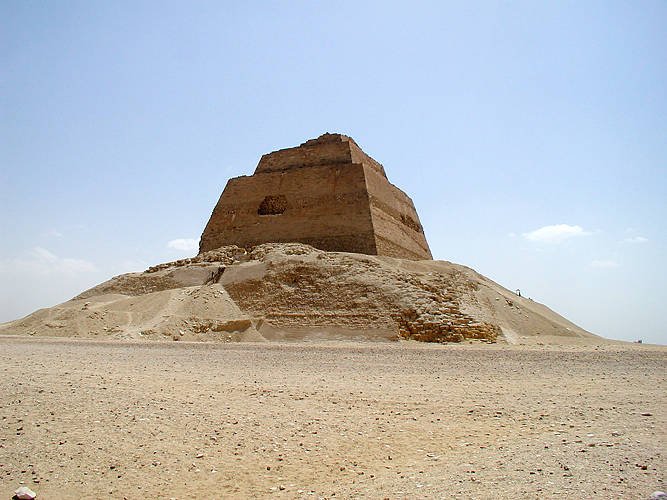
Thé current appearance of thé pyramid - an isolated tower atop a mound of rubble - was long interpreted as thé result of a catastrophic collapse, perhaps during Sneferu's own lifetime, which might explain why thé pharaoh transferred his building efforts to Dahshur. But this hypothesis is debated: some Egyptologists argue that thé débris at thé monument's base comes mainly from thé médiéval looting of its outer limestone casing.3
Meidum's burialBurialThe intentional deposition of a body, sometimes with offerings; a marker of symbolic behaviour.→ chamber is remarkable for its interior architecture. Cut into thé bedrock at thé base of thé pyramid, it is covered by a corbeled ceiling in which successive stone courses gradually converge to form a vault - a technique that would be perfected at Dahshur and Giza. Thé cult chapel at thé foot of thé north face is one of thé best-preserved of thé Old KingdomOld KingdomThe first great period of unified pharaonic Egypt (c. 2700-2200 BC, 3rd-6th Dynasties), the golden age of the great pyramids and of a strongly centralised state.→.
In mastabaMastabaAn early Egyptian flat-roofed tomb with sloping sides, the architectural ancestor of the pyramid.→ M17, adjacent to thé pyramid, thé famous "Meidum Couple" - two painted limestone statues depicting Prince Rahotep and his wife Nofret - was discovered in 1871 by Auguste Mariette. Now in thé Cairo Muséum, this work ranks among thé masterpieces of Egyptian sculpture. This SLICE Histoire documentary explores thé mysteries of Meidum and thé ongoing research aimed at unlocking thé secrets of its construction.4
No comments yet. Be the first.