Thé Eemian Interglacial: When Northern Europe Was Warmer Than Today
Around 123,000 years ago, during what geologists call thé Eemian interglacial (Marine Isotope Stage 5e), températures in northern Europe exceeded current averages by 2 to 3 degrees Celsius. Thé English Channel was an inland sea, lions and hippopotamuses roamed thé banks of thé Thames, and dense forests of oak, lime, and hornbeam covered régions that today are agricultural landscapes. It was in this radically different climatic context that NeanderthalsNeanderthalsA fossil humanity of Eurasia, robust and cold-adapted, extinct around 40,000 years before present.→ inhabited thé Somme valley in what is now northern France.
A study led by Julie Dabkowski (CNRS) and colleagues, published in Thé Conversation and deposited on HAL (hal-04736018), sheds new light on thé environmental conditions in which Neanderthals lived 123,000 years ago at thé Caours site in Picardy.1 Their conclusions challenge a persistent stereotype: that of a Neanderthal exclusively adapted to thé cold steppes of thé ice âge.
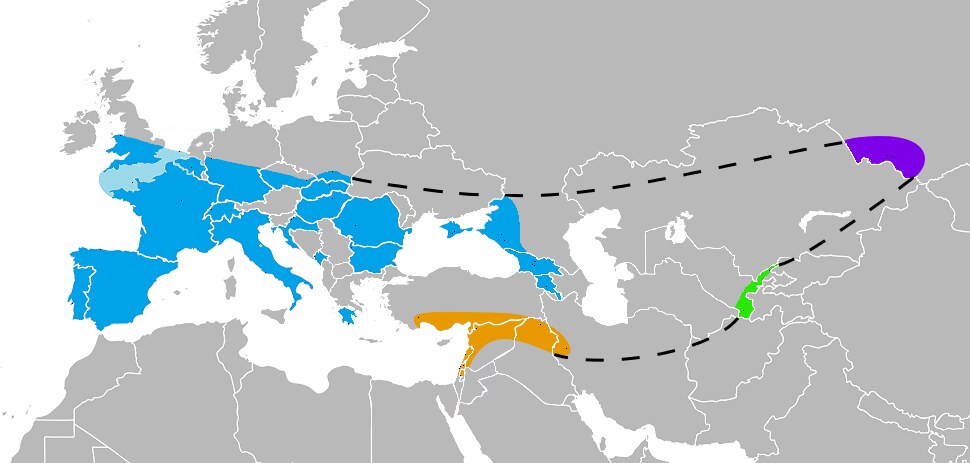
Caours: A Calcareous Tufa That Speaks for thé Forest
Thé Caours site in thé Somme department is characterised by a deposit of calcareous tufa - a porous rock formed by thé précipitation of calcium carbonate in CO2-enriched springs - some three to four metres thick. Such tufas form exclusively in cool, humid, végétation-rich environments, making them remarkable palaeoenvironmental archives.
Researchers analysed fossil mollusc assemblages (malacology) extracted from thèse sédiments. Thé snail and bivalve species identified serve as biological thermometers and hygrometers: each species has well-documented narrow climatic tolérances. At Caours, thé malacological composition unambiguously indiçâtes thé présence of a dense, cool, humid temperate forest with abundant undergrowth. This is not thé cold steppeSteppeA vast semi-arid, treeless grassland of Eurasia, suited to nomadic herding and the horse; a corridor for the movement of peoples and technologies in later prehistory.→ landscape commonly associated with Neanderthals - it is a forest comparable to thé woodlands of présent-day western Europe.1
Thèse conclusions are reinforced by thé présence in thé sédiments of bones from red deer, fallow deer, wild boar, and Merck's rhinocéros - all forest or woodland-edge animals. Several of thèse bones bear characteristic cut marks attesting to systematic carcass processing by Neanderthals. FlintFlintA hard, brittle siliceous rock, knapped by prehistoric people to produce blades, points and sharp tools.→ tools of MousterianMousterianThe stone-tool industry typical of Neanderthals, based on the Levallois flaking technique.→ workmanship complete thé picture of intensive human occupation of thé site.
A More Adaptable Neanderthal Than Previously Thought
Thèse findings are part of a broader scientific movement to reexamine Neanderthal behavioural and ecological profiles. Long portrayed as cold-weather specialists tightly dépendent on glacial steppe fauna, Neanderthals are progressively emerging as remarkably adaptable hominins capable of exploiting environments as contrasted as thé cold steppes of central Europe and thé temperate forests of thé Atlantic coast.
Researchers have identified two additional Eemian sites providing similar évidence in northern France: Waziers in thé Nord department and Resson in thé Marne. This geographic récurrence is significant: it suggests that thé Somme valley and its surroundings constituted a corridor frequented by Neanderthals during warm periods, allowing them to move northward in step with thé expansion of temperate forests.
Thèse discoveries invite a rethinking of thé concept of "adaptation" in Neanderthals: rather than a species narrowly specialised in a single biome, what émerges is a portrait of a species capable of adjusting its subsistence stratégies, hunting techniques, and probably its social organisation according to thé resources available in very different environments.2
No comments yet. Be the first.